Category 1, 2, and 3 Water Damage: What Lakewood Homeowners Need to Know
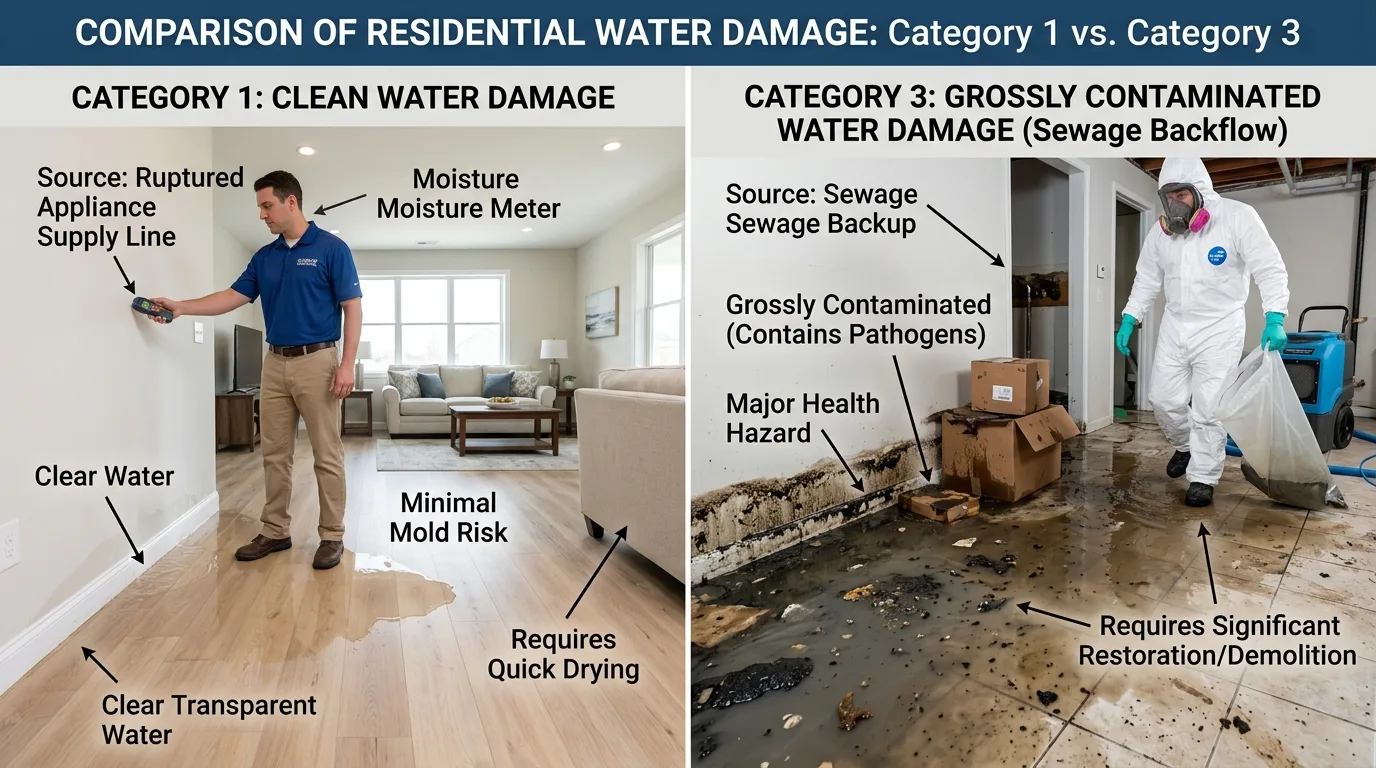
Restoration professionals handle your water damage differently depending on one critical factor: what kind of water caused it. The IICRC S500 standard classifies water damage into three categories based on contamination level, and those categories determine everything — what equipment is used, which materials can be dried in place versus replaced, what PPE technicians must wear, and how much your restoration will cost. Lakewood homeowners who understand these categories can better assess their situation, ask the right questions, and avoid the common mistake of assuming all water damage is equivalent. Here’s what each category means and how it plays out in real Lakewood water damage events.
Water Damage in Your Lakewood Home? We Assess and Respond Correctly.
Call (877) 698-1311 — IICRC-certified technicians respond 24/7 throughout Jefferson County.
Category 1: Clean Water — The Best Case Scenario
Category 1 water originates from a sanitary source — a supply line, a water heater, or a faucet overflow. It poses no health risk at the point of contact and can be safely touched without PPE. Common Category 1 events in Lakewood include burst copper supply lines (particularly during the winter freeze-thaw cycles that make burst pipe repair one of our most common emergency calls), dishwasher overflows from failed door seals, and water heater discharge from pressure relief valves.
The important caveat: Category 1 water degrades to Category 2 within 24–72 hours of contact with structural materials, biological agents, and ambient conditions. A burst pipe discovered within two hours and immediately extracted is a Category 1 event. The same burst pipe discovered the next morning — after the water has been in contact with drywall, insulation, and flooring overnight — is likely Category 2 by the time restoration begins. This degradation is why response timing matters so much in water damage restoration.
Typical Lakewood response: Extraction with truck-mounted equipment, structural drying with commercial dehumidification, daily moisture monitoring. Porous materials can often be dried in place if Category 1 status is confirmed and extraction was prompt. Water extraction alone for a contained Category 1 event typically costs $1,200–$3,000.
Category 2: Gray Water — Elevated Contamination Requiring Caution
Category 2 water contains significant contamination — not the pathogen load of sewage, but enough chemical or biological content to cause health discomfort or illness upon contact or ingestion. Common Category 2 sources in Lakewood include: washing machine discharge (contains detergent residue and biological contaminants from laundry), aquarium overflow, sump pump failure water (groundwater drawn up with soil contaminants), and water that has been classified Category 1 but degraded during an extended event.
Category 2 restoration requires enhanced protective measures — technicians wear gloves and appropriate respiratory protection — and porous materials that have been saturated by Category 2 water are typically removed and replaced rather than dried in place, because the contamination cannot be adequately reduced through drying alone. This material replacement is what drives Category 2 costs above Category 1 even when the volume of water and affected area are identical.
Typical Lakewood response: Extraction, material assessment and selective removal, antimicrobial application to affected surfaces, commercial dehumidification and structural drying. Category 2 events in Lakewood typically cost $2,500–$5,000 for mitigation depending on affected area.
Not Sure What Category Your Water Damage Is? Call Us.
We assess and classify correctly — determining category determines everything else. Call (877) 698-1311.
Category 3: Black Water — The Highest Risk, Requiring Strict Protocol
Category 3 water is grossly contaminated — containing pathogens (bacteria, viruses, parasites) at levels that present direct health hazards. Sewage cleanup is the most common Category 3 scenario, but Category 3 also includes floodwater that has entered from outside the structure (carrying soil contaminants, pesticides, and biological material), toilet overflow with feces, and any water that has been standing long enough to support dangerous microbial growth.
Category 3 events in Lakewood are most common in the Eiber and Kendrick Lake neighborhoods, where aging sewer laterals cause periodic sewage backups, and during summer thunderstorms when municipal sewer capacity is overwhelmed and backflow occurs into basement floor drains. Category 3 restoration requires full PPE — Tyvek suits, respirators, chemical-resistant gloves — and mandatory replacement of all porous materials (carpet, drywall, insulation) that had Category 3 contact. No exception to material replacement applies regardless of how quickly response occurs.
Typical Lakewood response: Full PPE protocols, physical containment, mandatory porous material removal and OSHA-compliant disposal, non-porous surface decontamination with EPA-registered disinfectants, HEPA air scrubbing, post-remediation verification. Category 3 events in Lakewood typically cost $5,000–$8,000+ for mitigation, with reconstruction adding significantly to the total.
How Water Category Affects Your Insurance Claim in Lakewood
Water category is a factor in insurance claim processing. Most homeowner’s policies cover sudden and accidental water damage regardless of category for supply-line and appliance events. Sewage backup coverage requires a specific rider on a standard policy — without it, a Category 3 sewage event is not covered regardless of cause. Exterior floodwater (Category 3 by definition) requires a separate NFIP or private flood insurance policy.
The restoration company’s classification of your event affects how they document the claim. A company that misclassifies a Category 2 or 3 event as Category 1 to reduce their work scope creates a documentation problem: the insurer’s adjuster may inspect and find evidence of contamination inconsistent with the documentation, leading to claim disputes. We document category classification with written assessment notes and, for Category 3 events, include the evidence supporting the classification.
Frequently Asked Questions
How do I know what category my water damage is in Lakewood?
The easiest initial assessment is source identification: clean supply line = Category 1, washing machine or sump water = Category 2, toilet/sewage = Category 3. However, any event where the source is unclear, or where the water has been present for more than 24 hours, requires professional assessment. We classify every event during our initial inspection and document the classification basis.
Can Category 2 or 3 water damage be cleaned up without removing drywall in Lakewood?
No. IICRC standards require removal of porous materials that have been saturated by Category 2 or 3 water — drywall, insulation, carpet — because these materials cannot be adequately decontaminated in place. Any restoration company that dries Category 2 or 3-saturated drywall in place is not following IICRC S500 standards and is leaving contamination in your structure. This is a significant health and mold risk.
What causes Category 1 water to become Category 3 over time in Lakewood?
Category 1 water degrades as it contacts biological material in the environment — organic debris in carpet, mold spores in structural cavities, bacteria naturally present in soil and building materials. Given 72 hours or more, formerly clean water in a saturated wall cavity can test at Category 2 or Category 3 levels. This is why same-day extraction is not merely a preference but a genuine factor in whether material can be salvaged versus replaced.
Know Your Category, Know Your Response — Call Lakewood's Experts
Lakewood Water Damage Pros — accurate category assessment and correct protocol on every call. (877) 698-1311.
Related: