Mold After Water Damage: Lakewood Homeowner's Guide
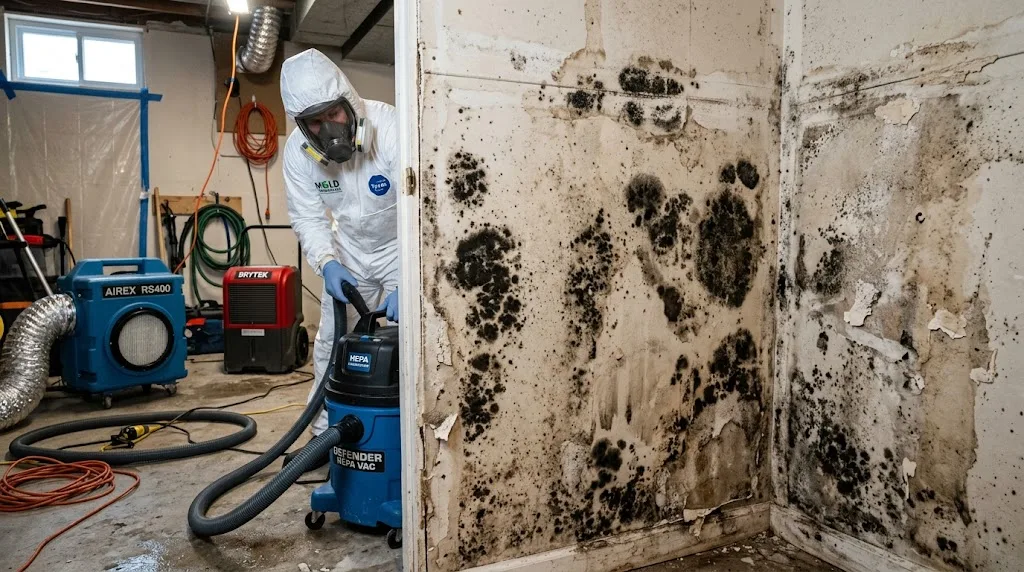
Every Lakewood homeowner who has dealt with water damage asks the same question at some point: “Is there mold?” The answer depends on one variable above all others — time. Mold colonization in a moisture-saturated environment begins within 24–48 hours. If your water damage was addressed within that window with professional extraction and structural drying, mold is unlikely. If water sat for longer, or if dehumidification was inadequate, mold is almost certain — whether you can see it or not. This guide explains mold’s growth timeline in Lakewood’s specific climate, what IICRC-certified mold remediation looks like, and how to know if your previous water damage event left hidden mold behind.
Concerned About Mold After Water Damage in Lakewood?
Call (877) 698-1311 — our IICRC-certified team provides mold assessment and remediation throughout Jefferson County.
Why Mold After Water Damage Is a Particular Risk in Lakewood
Mold needs three things to establish: moisture, organic material, and a temperature range between roughly 40°F and 100°F. Lakewood homes — particularly the mid-century construction in the Applewood and Belmar neighborhoods — provide all three in abundance after a water event. The organic material is the wall framing, drywall paper facing, and subfloor assemblies that make up the structure. The temperature range is met year-round in occupied spaces. The only variable is moisture — and once a water damage event introduces sustained moisture into structural cavities, mold has everything it needs.
Lakewood’s semi-arid climate creates a counterintuitive risk: because outdoor air is dry, homeowners sometimes assume moisture inside the home will dry naturally. In unaffected surface areas of a home, this is often true. But inside a wall cavity where wet insulation holds humidity at 90%+ against wood framing, the outdoor dryness is irrelevant. The interior microclimate within that cavity is identical to the high-humidity environments where mold thrives everywhere. Professional dehumidification is necessary to change the conditions inside the cavity — outdoor air exchange is insufficient.
Mold’s Growth Timeline After Water Damage in Lakewood
0–24 hours: Mold spores (which are always present in any indoor environment) begin attaching to wet surfaces. No visible growth yet, but the colonization process has started.
24–48 hours: First-generation mold colonies begin producing visible growth on highly porous materials — drywall paper, cardboard, insulation. At this stage, surface mold is relatively contained and mold remediation is straightforward.
48–72 hours: Mold spreads to adjacent surfaces via spore release. Wall cavities with elevated humidity begin hosting growth on framing and behind insulation — growth that will not be visible from the room surface.
1–2 weeks: Mold has thoroughly colonized porous structural materials. Musty odor becomes noticeable. Spore counts in the air begin to rise, potentially triggering respiratory symptoms in sensitive occupants.
2–6 weeks: Hidden mold behind walls can become extensive. Structural material may be compromised. Full mold remediation requiring demolition and replacement of affected materials becomes necessary.
What IICRC-Certified Mold Remediation Looks Like
The IICRC S520 standard for mold remediation defines a process that is substantially different from simply spraying bleach on visible mold growth. IICRC-certified remediation follows these core steps:
Containment. Before any mold is disturbed, the affected area is physically contained using poly sheeting and negative air pressure. Air movers exhaust contaminated air through HEPA filters out of the contained zone, preventing spores from spreading to unaffected areas. Any company that begins mold removal without establishing containment is not performing IICRC-standard remediation.
Personal protective equipment. Technicians wear N-95 or higher respirators, Tyvek suits, and gloves throughout the remediation process. Mold spore inhalation is a health hazard — proper PPE is non-negotiable.
HEPA vacuuming and wet wiping. Mold-affected surfaces are vacuumed with HEPA-filter vacuums and then wet-wiped with antimicrobial solution before any demolition or material removal begins. This step captures surface spores before they become airborne.
Material removal. Drywall, insulation, and other porous materials with mold penetration are removed and disposed of in sealed bags. Non-porous surfaces (concrete, metal, sealed wood) can typically be cleaned rather than removed.
Antimicrobial treatment. EPA-registered antimicrobials are applied to all remediated surfaces and allowed to dwell for the specified contact time.
Post-remediation verification. Air quality sampling by an independent industrial hygienist confirms that spore counts have returned to normal ambient levels before the containment is removed and reconstruction begins.
IICRC-Certified Mold Remediation in Lakewood, CO
We follow the S520 standard on every project — containment, removal, clearance testing. Call (877) 698-1311.
How to Tell If Previous Water Damage Left Hidden Mold
If your Lakewood home experienced water damage in the past — especially if it was handled without professional structural drying equipment — there may be hidden mold present that was never detected. These indicators suggest hidden mold may be present:
- Persistent musty odor in specific rooms or the basement that doesn’t clear with ventilation
- Unexplained respiratory symptoms (coughing, congestion, sneezing) that improve when you leave the home
- Water stains on walls or ceilings that appeared after a past water event and were painted over without professional drying
- Visible mold on surfaces adjacent to areas where previous water damage occurred
- The water event was not addressed with professional dehumidification equipment
Thermal imaging and air quality testing can confirm or rule out hidden mold without opening walls. If testing confirms elevated mold spore counts in areas where no visible growth exists, targeted wall opening and assessment identifies the extent of hidden growth.
Frequently Asked Questions
How long does mold remediation take after water damage in Lakewood?
Single-room contained mold remediation takes 1–2 days. Extensive hidden mold in wall cavities — common in older Belmar and Eiber homes after long-term moisture intrusion — takes 3–5 days including containment setup, material removal, treatment, and air quality verification. Reconstruction of removed materials follows as a separate phase.
Does homeowner’s insurance cover mold remediation in Lakewood?
Insurance covers mold remediation when it results from a covered water loss event — a burst pipe or appliance failure, for example. Mold that results from gradual seepage, inadequate maintenance, or pre-existing conditions is typically excluded. Document any water event promptly and call your insurer. We provide full thermal imaging and moisture documentation to support your claim. See our insurance claim guide for Lakewood for details.
Is DIY mold removal safe in Lakewood homes?
DIY mold treatment is appropriate only for very small areas (under 10 square feet) of surface mold on non-porous materials. Any mold on drywall, insulation, or framing — or any mold in a wall cavity — requires professional IICRC-certified remediation with proper containment. Attempting to clean mold in a wall cavity without containment releases millions of spores into the living environment, spreading contamination to previously clean areas.
Don't Let Mold Spread Further — Act Now
Lakewood Water Damage Pros provides IICRC-certified mold remediation throughout Lakewood and Jefferson County. Call (877) 698-1311.
Related: