7 Steps to Take Immediately After Water Damage in Your Lakewood Home
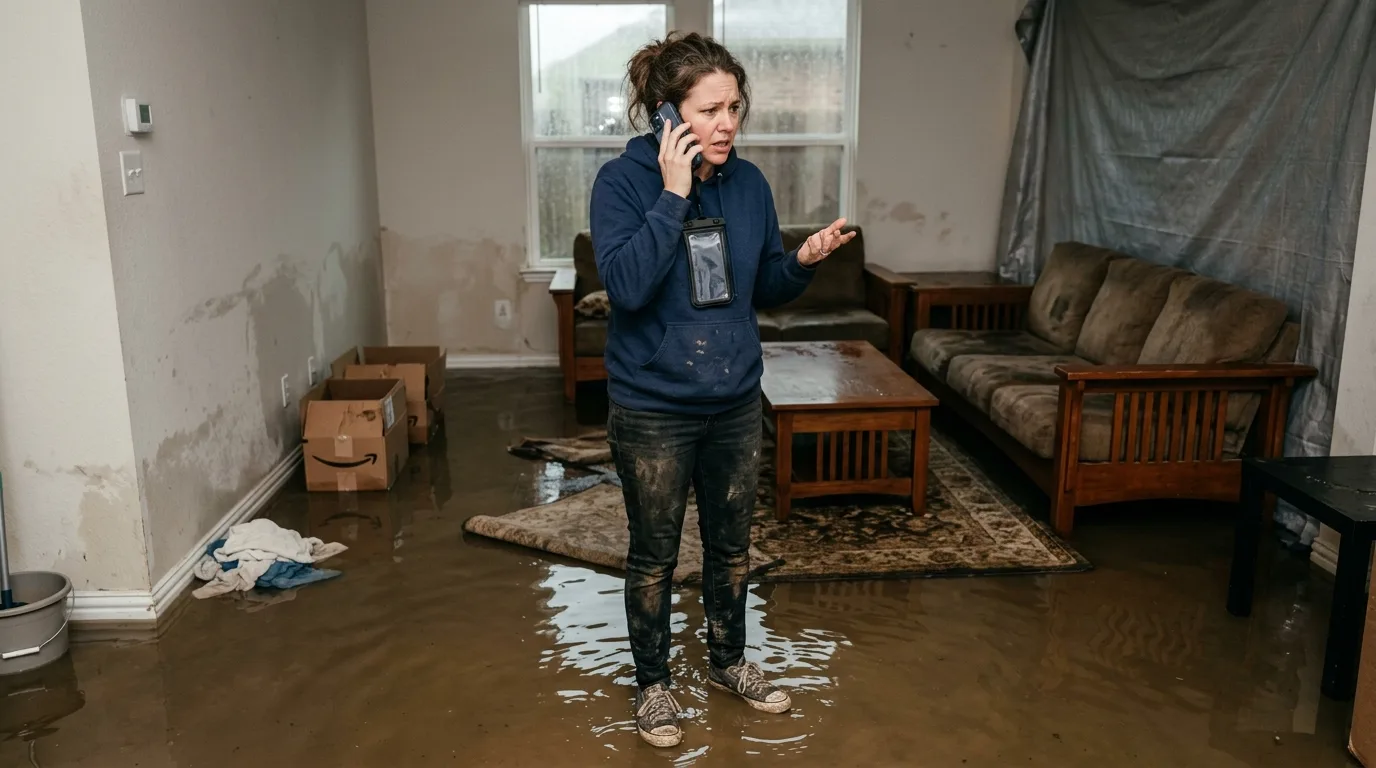
The first hour after discovering water damage in your Lakewood home determines the difference between a $2,000 mitigation job and a $12,000 restoration project. Water moves fast — particularly in homes built on Jefferson County’s clay soils, where moisture wicks through concrete foundation walls, saturates batt insulation, and penetrates wall cavities faster than most homeowners expect. Most of the serious, costly water damage isn’t caused by the initial event — it’s caused by the hours that pass before proper response begins. If you’ve just discovered water damage in your Lakewood home, follow these seven steps immediately. If you’re reading this before an event, bookmark it now.
Water Damage Just Happened in Your Lakewood Home? Call Now.
(877) 698-1311 — 24/7 emergency response throughout Lakewood and Jefferson County. 60-minute dispatch.
Step 1: Cut Power to the Affected Area
Before entering any area with standing water, go to your electrical panel and turn off the circuit breakers serving the affected space. Electricity and standing water are a lethal combination — even a shallow puddle can conduct enough current to cause electrocution if an outlet, appliance, or exposed wiring is in contact with the water.
If the electrical panel itself is in the flooded area and you cannot safely reach it, do not enter the space. Call us from outside the area — we arrive with appropriate safety protocols for electrically hazardous water damage scenarios. Do not assume a space is safe because it “looks fine” — energized water is invisible.
Step 2: Stop the Water Source
If water is still actively entering the structure — a burst pipe, overflowing appliance, or active leak — stop the source before anything else. For a pipe burst, close the main water shutoff valve (typically in the basement utility area near the water meter). For an appliance overflow, pull the appliance’s power plug and close the supply valve behind it.
If you cannot identify or reach the water source, call Lakewood Water Damage Pros at (877) 698-1311 immediately — do not let water continue flowing while you assess the situation.
Step 3: Document Everything Before Touching Anything
Your insurance claim depends on original documentation. Before any cleanup, extraction, or item removal:
- Photograph every affected area from multiple angles — show water depth, source, and all affected surfaces
- Video walk the entire affected zone while narrating what you’re seeing
- Take close-up photos of the apparent source — the burst pipe, overflow point, or storm entry
- Time-stamp everything using your phone’s camera timestamp
Do not mop, vacuum, or begin cleanup before documenting. Once cleanup begins, the original damage evidence is gone. Insurance adjusters work from documentation — what you don’t photograph doesn’t exist for claims purposes.
Step 4: Remove What You Can Safely
After documentation is complete, safely remove items from the water that can be salvaged:
- Move furniture, rugs, and personal property to a dry area
- Remove area rugs from hardwood floors — wet rugs sitting on hardwood will stain the wood within hours
- Place aluminum foil or wood blocks under furniture legs that must remain in the wet area to prevent staining
- Move electronics and irreplaceable items first
Do not remove flooring, baseboards, or structural components — that determination belongs to the restoration professional who must assess what can be dried versus what must be replaced.
Need Help With Water Damage Steps in Lakewood? We Respond Now.
Call (877) 698-1311 — our team guides you through the process and arrives within 60 minutes.
Step 5: Call a Restoration Company Immediately
Call Lakewood Water Damage Pros at (877) 698-1311 now — not after the adjuster visits, not in the morning, not after you’ve assessed more thoroughly. The window for preventing mold growth is 24–48 hours, and water extraction and structural drying must begin within that window to preserve that window.
We respond to water damage emergencies throughout Lakewood — from the Green Mountain neighborhood on the west side to properties near Bear Creek Lake Park in the south — as well as throughout Jefferson County. Our dispatch target is on-site within 60 minutes. Do not wait.
Do not use a household wet-vac and fans as a substitute for calling a restoration company. Consumer equipment cannot match the extraction volume or dehumidification capacity of commercial equipment, and it cannot provide the thermal imaging moisture detection that identifies hidden moisture in wall cavities and subfloor assemblies.
Step 6: Notify Your Insurance Company
Call your homeowner’s insurance company within 24 hours of discovering the damage. When you call:
- Provide your policy number
- Describe the event and date/time of discovery
- Ask specifically: Is this type of event covered? What is my deductible? What documentation will the adjuster need?
- Request expedited adjuster scheduling
Do not tell the insurer you have already begun cleanup — frame your actions as protective measures to prevent further damage, which is your policy obligation. The adjuster will typically schedule an inspection within 2–5 business days. We provide complete documentation — thermal imaging reports, moisture logs, and scope of loss — for every project to support your claim.
Step 7: Prevent Additional Moisture Entry
While restoration is in progress, take steps to prevent additional moisture from entering the structure:
- Tarp any roof openings or exterior damage that could allow rain entry
- Install temporary covers over broken windows
- Keep HVAC set to normal temperature — do not turn off heating in winter, as frozen pipes in a water-damaged structure create a second emergency
For spring snowmelt events near the Bear Creek watershed and Kendrick Lake areas, monitor sump pump operation throughout the restoration period — a pump that fails while drying equipment is in the basement creates a reset of the entire drying process.
Frequently Asked Questions
Can I do the cleanup myself after water damage in my Lakewood home?
Surface cleanup of small, contained Category 1 events — a small appliance overflow on a tile floor, for example — can be handled without professional help if the area is completely dried within 24 hours and no structural materials were saturated. Any event that has affected drywall, insulation, subfloor, or wall cavities requires professional structural drying to prevent mold. When in doubt, call — a professional assessment costs nothing and eliminates uncertainty about mold risk.
What happens if I wait more than 24 hours to address water damage in Lakewood?
Mold colonization begins at 24–48 hours in moisture-saturated environments. Materials that could have been dried and salvaged within the first 24 hours typically require removal and replacement after 48–72 hours of saturation. In Lakewood’s clay-soil environment, where moisture wicks from below-grade contact points, the internal cavity humidity remains high even when surface materials appear to begin drying — giving mold everything it needs to establish within the first day.
Should I call a plumber or a restoration company first after a burst pipe in Lakewood?
Call both simultaneously — they handle different problems. The plumber repairs the pipe; the restoration company extracts the water and dries the structure. Neither can do the other’s job. If you can only make one call immediately, call the restoration company first if the pipe is already shut off — the active water damage is the more time-sensitive issue once the source is controlled.
7 Steps, 60 Minutes, 24/7 — That's How Lakewood Water Damage Pros Responds
Call (877) 698-1311 the moment you discover water damage anywhere in Lakewood or Jefferson County.
Related: