Same-Day Water Extraction in Lakewood: What to Expect
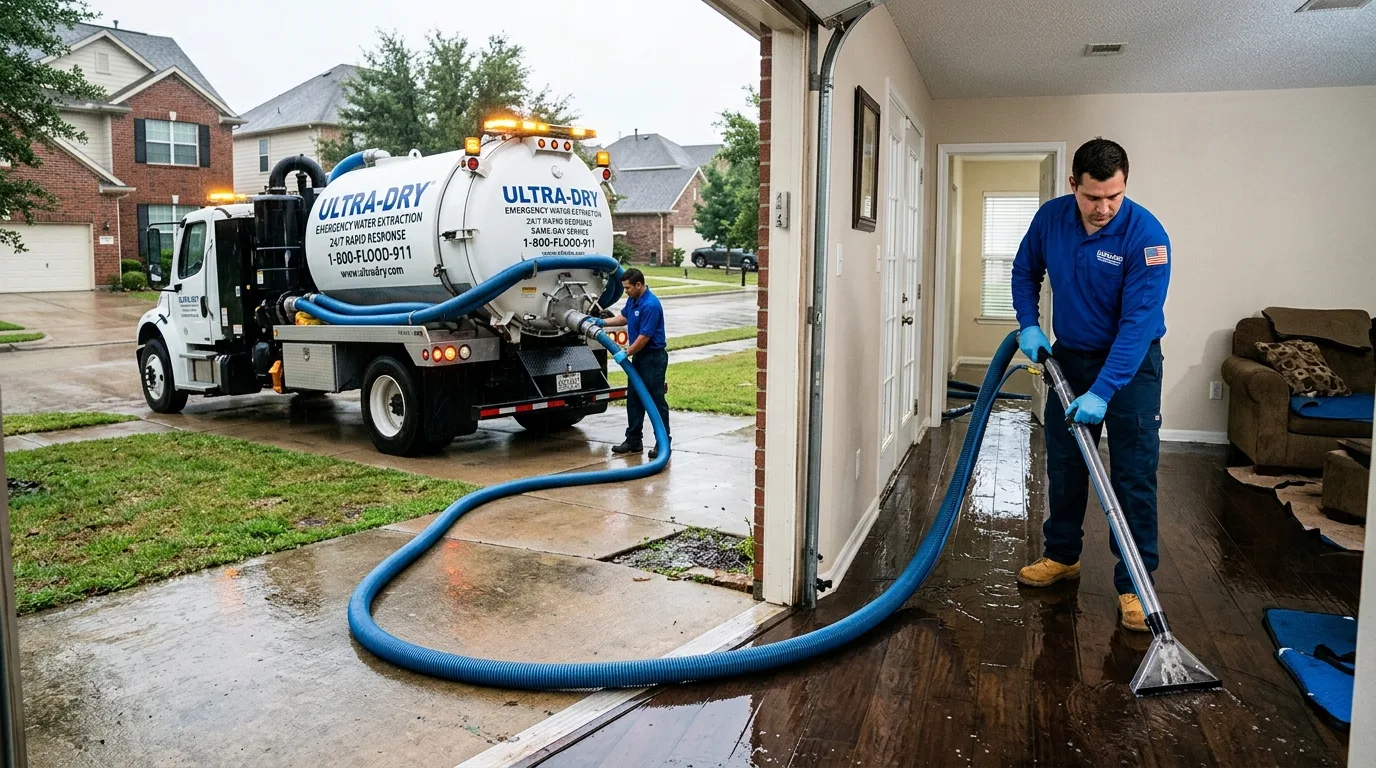
When a pipe bursts at 2 a.m. or your Lakewood basement fills with snowmelt on a Sunday morning, “same-day water extraction” sounds like exactly what you need. But what does it actually mean? What equipment arrives, what does the technician do, and what happens after the visible water is gone? Many Lakewood homeowners are surprised to learn that extraction — removing standing water — is only the first step in a multi-day process. Understanding the complete timeline helps you know what to expect, what questions to ask, and how to avoid a situation where the restoration company declares the job “done” while moisture remains in your structure. This post walks through the complete same-day extraction and drying process from the first call to certified completion.
Same-Day Water Extraction Available 24/7 in Lakewood
Call (877) 698-1311 — we dispatch immediately throughout Lakewood and Jefferson County.
What Happens When You Call for Emergency Water Extraction in Lakewood
When you call Lakewood Water Damage Pros, your call goes directly to a dispatcher — not a voicemail or answering service — who gathers essential information: the source of the water, the approximate volume and affected area, whether power has been shut off to the affected area, and your exact location. Based on this information, the nearest available team is dispatched with the equipment sized for your situation.
Our target response time throughout Lakewood is 60 minutes or less. Response to the Applewood, Green Mountain, and Kendrick Lake neighborhoods typically falls within this window. Response to more rural-adjacent areas near Bear Creek Lake Park may be slightly longer. We confirm estimated arrival time during your call.
Phase 1: Arrival, Safety Assessment, and Moisture Mapping (0–1 Hour)
The extraction team arrives with truck-mounted extraction equipment, a thermal imaging camera, calibrated moisture meters, and personal protective equipment appropriate for the water category.
Before any equipment is turned on, the technician performs a safety assessment: confirming that power to the affected area is off and that the water source has been controlled (pipe shutoff, sump pump issue addressed, appliance disconnected). An uncontrolled water source must be resolved before extraction begins — removing water while more is entering is ineffective.
With safety confirmed, thermal imaging inspection maps the full extent of water migration. This step is critical and separates professional restoration from amateur cleanup: water that has traveled behind walls, under flooring, or into ceiling cavities must be identified before it can be addressed. Moisture meters confirm saturation levels in materials throughout the affected area.
Phase 2: Water Extraction (1–4 Hours)
Truck-mounted extractors connect directly to the van’s power source and generate far greater suction than any portable equipment. Standing water in an average Lakewood basement (600–800 square feet, 2–4 inches deep) is extracted in approximately 30–60 minutes with truck-mounted equipment versus several hours with portable equipment.
Carpet and subfloor assemblies require additional extraction passes — water that has penetrated into carpet backing and OSB or plywood subfloor does not release easily and requires multiple passes with weighted extraction heads. Dehumidification is the tool that ultimately removes this embedded moisture, not extraction alone.
After visible water is removed, the extraction team evaluates whether affected structural materials (carpet, drywall, insulation) can be salvaged with drying or must be removed for successful remediation. Category 1 clean water events caught early often allow carpet and drywall to be dried in place. Category 2 or 3 events, or events with extended exposure time, typically require material removal before drying equipment is placed.
Professional Water Extraction in Lakewood — Immediate Dispatch
We arrive within 60 minutes throughout Lakewood. Call (877) 698-1311 now.
Phase 3: Structural Drying Setup (During and After Extraction)
As extraction nears completion, the team places commercial LGR (Low Grain Refrigerant) dehumidifiers and high-velocity air movers in calculated positions throughout the affected area. The number and placement of these units is determined by psychrometric calculations — not guesswork. Lakewood’s altitude (approximately 5,400 feet) and semi-arid ambient air conditions affect the psychrometric parameters used for these calculations.
In Jefferson County basements with clay-soil foundations, additional attention is given to wall assemblies in contact with below-grade concrete — these surfaces release moisture more slowly than above-grade framing and may require directed airflow and additional dehumidifier capacity.
A baseline moisture reading is documented at equipment setup. Daily moisture monitoring follows, with readings taken at the same measurement points each day to track progress. Sump pump failure situations — a common Lakewood emergency — require confirming the pump is operational or a temporary pump is in service before the sump pit fills again during the drying period.
Phase 4: Drying Monitoring and Completion (Days 1–7)
Structural drying in Lakewood homes typically takes 3–7 days from extraction through certified completion. Daily site visits confirm drying progress and adjust equipment positioning as needed. Equipment is not removed until every moisture reading confirms the structure has reached target moisture content — below 16% for wood framing, appropriate levels for concrete and other materials.
At completion, a final thermal imaging scan and moisture reading set is documented and provided to you as your drying completion certificate. This document is required by insurance carriers to confirm that drying was completed to IICRC standards and provides proof that hidden moisture was not left in the structure.
Frequently Asked Questions
How long does same-day water extraction actually take in Lakewood?
Extraction itself — removing standing water — takes 30 minutes to 4 hours depending on volume and affected area. Bear Creek and Kendrick Lake basement floods with several inches of standing water take the longer end. The complete restoration process including structural drying takes 3–10 days. “Same day” refers to when we arrive and begin extraction, not when the entire process concludes.
Can I stay in my home during water extraction and drying in Lakewood?
In most cases, yes — if the affected area is limited to a basement or single room and the water source is clean. Sewage backup events require vacating the affected area until remediation is complete. For above-living-space events where ceiling materials have been saturated, staying may be inadvisable depending on structural safety. We advise on occupancy safety during the initial assessment.
What’s the difference between a portable dehumidifier and commercial drying equipment?
A standard consumer dehumidifier removes 30–70 pints of water per day. Commercial LGR dehumidifiers remove 150–250+ pints per day and are specifically designed to operate efficiently at the lower grain per pound humidity conditions of Colorado’s semi-arid climate. For structural drying in a water-damaged home, commercial equipment achieves certified dry conditions 3–5 times faster than consumer equipment — significantly reducing mold risk and restoration cost.
Same-Day Extraction and 7-Day Structural Drying in Lakewood
Call Lakewood Water Damage Pros at (877) 698-1311 — 24/7 dispatch, complete drying process, insurance documentation.
Related: