Top 5 Water Damage Restoration Myths Every Lakewood Homeowner Should Know
What if the water damage advice you’ve gotten from your neighbor, your general contractor, or the internet is costing you thousands of dollars? Some of the most widely repeated water damage beliefs — about drying times, mold risk, insurance coverage, and when professional help is necessary — are simply wrong. And in Lakewood, where Jefferson County’s clay soils create a moisture environment that behaves differently than most of the country, acting on wrong information doesn’t just waste money — it can turn a $2,000 mitigation job into a $15,000 mold remediation. Here are the five most dangerous water damage myths we encounter in Lakewood homes, and what’s actually true.
Get the Facts About Water Damage Restoration in Lakewood
Call (877) 698-1311 — honest assessments, IICRC-certified work, and transparent pricing throughout Jefferson County.
Myth 1: “It Dried Out on Its Own — It’s Fine”
This is the most expensive myth in water damage restoration. Visible surface drying — the surface of your drywall looks dry to the touch, the carpet feels mostly normal — does not mean the structure is dry. Structural drying requires that moisture levels in wall framing, subfloor assemblies, and insulation return to target thresholds (below 16% moisture content for wood) as measured by calibrated moisture meters and confirmed by thermal imaging moisture detection.
In Lakewood homes with clay-soil foundation contact, wall cavities and below-grade concrete retain elevated moisture for weeks after a surface appears dry. Mold is establishing in that cavity the entire time. The most common scenario we see in the Applewood and Kendrick Lake neighborhoods is a homeowner who had a water event 2–4 months ago, “let it dry out,” and is now calling because they’ve noticed a musty odor or visible mold growth behind an interior wall.
The truth: Visible surface drying confirms nothing about structural moisture levels. Only calibrated moisture meter readings and thermal imaging confirm actual dry conditions. If your water event was not monitored to certified dry standards with documentation, you don’t know if it’s actually dry.
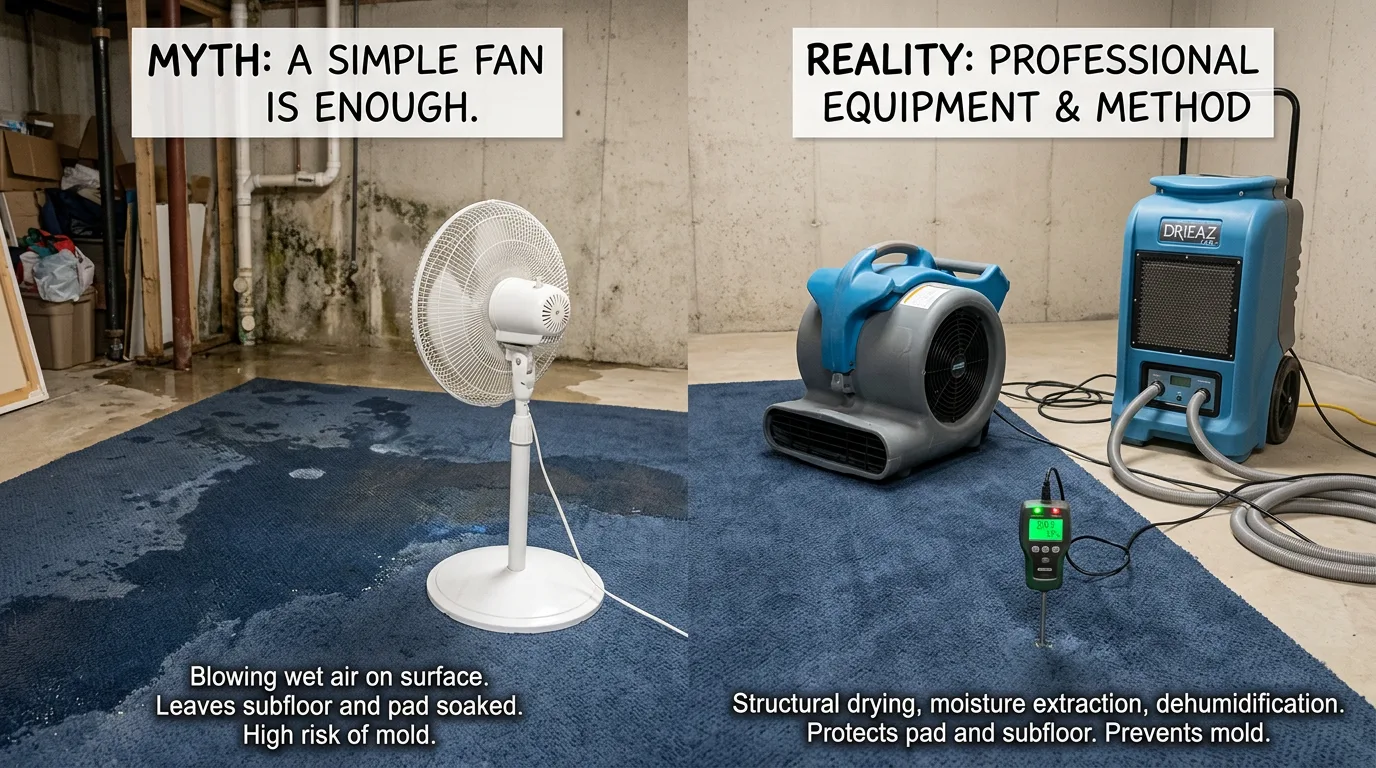
Myth 2: “Box Fans and a Dehumidifier Are All You Need”
Consumer equipment has its place — for surface-level moisture on a small area after a minor spill. For structural water damage affecting wall cavities, subfloor, and insulation, consumer equipment is inadequate in two important ways.
First, output volume: a consumer dehumidifier removes 30–70 pints of moisture per day. A commercial LGR dehumidifier removes 150–250+ pints per day. In a wet Lakewood basement, this difference is the difference between 3-day and 3-week drying timelines — and mold doesn’t wait three weeks. Second, equipment placement: commercial air movers and dehumidifiers are positioned using psychrometric calculations that account for Lakewood’s altitude (approximately 5,400 feet), ambient humidity, and temperature to achieve targeted drying rates. Random fan placement generates airflow without achieving the pressure differential needed to draw moisture from structural cavities.
The truth: Commercial structural drying equipment achieves certified dry conditions 3–5x faster than consumer equipment and is the only path to documented, verifiable drying completion that insurance carriers recognize.
Myth 3: “Mold Won’t Grow in Colorado Because It’s Too Dry”
Colorado’s low ambient humidity is a real advantage — but it doesn’t apply inside a saturated wall cavity. Once moisture enters a closed structural cavity, the relative humidity in that space approaches 100% regardless of what the outdoor air reads. Mold doesn’t need outdoor conditions; it needs the microclimate inside the cavity, which is perpetually high-humidity once structural saturation occurs.
We remediate mold in Lakewood homes throughout the year — including during winter and early fall, when outdoor humidity is at its lowest. The Belmar and Eiber neighborhoods contain homes where mold established during spring snowmelt events and was discovered the following fall when the homeowner noticed the odor intensifying. Semi-arid outdoor climate did not protect those wall cavities at all.
The truth: Colorado’s dry outdoor air helps accelerate structural drying when proper dehumidification equipment is used — but it has no effect on closed structural cavities where mold develops after water damage. Mold prevention requires professional structural drying, not Colorado weather.
Separate Myth from Reality — Get a Professional Assessment in Lakewood
Thermal imaging and moisture meter readings give you facts, not guesses. Call (877) 698-1311.
Myth 4: “My Insurance Will Cover Everything”
Insurance is a critical safety net for water damage events, but the coverage gaps are significant and widely misunderstood by Lakewood homeowners. Standard homeowner’s policies exclude:
- Gradual leaks — any leak that developed over time rather than occurring suddenly and accidentally
- Exterior flooding and snowmelt seepage — water entering from outside requires separate flood insurance
- Sewage backup — covered only with a specific backup rider on the policy
- Mold from neglect — mold that resulted from failure to address a water event promptly may be excluded
These exclusions affect a substantial portion of the water damage events we see in Jefferson County. Snowmelt basement flooding is excluded from most standard policies. Sewage backup in Eiber’s aging sewer infrastructure is excluded without a rider. Gradual pipe leaks that weren’t discovered for months are excluded regardless of the final water damage volume.
The truth: Review your specific policy before an event, not during one. Add a water backup rider if you don’t have one — the annual premium is typically $50–$150. Purchase separate flood insurance if you’re in or adjacent to the Bear Creek floodplain. When a covered event occurs, document everything and work with a restoration company that provides insurance-standard documentation.
Myth 5: “Any Contractor Can Handle Water Damage”
General contractors, handymen, and even some plumbers frequently offer water damage cleanup as a side service. The problem is that structural drying is a technical discipline — psychrometrics, moisture science, and IICRC S500 protocol — that requires specific training and certification that most general contractors don’t have. A contractor who doesn’t use thermal imaging cannot identify moisture in wall cavities. One who doesn’t take calibrated daily moisture readings cannot confirm drying completion. One who doesn’t understand psychrometric calculations cannot properly size or position drying equipment.
In Lakewood, the gap between a correctly executed and incorrectly executed drying job isn’t immediately visible — it shows up 2–3 months later as mold behind the wall, or as a denied insurance claim because the required documentation was never generated. IICRC WRT and ASD certification is the minimum credential that verifies a technician has been tested on the science of water damage restoration — not just the mechanics of showing up with equipment.
The truth: IICRC certification is not a marketing designation — it’s a tested competency credential. Verify that any water damage contractor you hire in Lakewood is IICRC-certified. Ask for certification numbers and verify at iicrc.org. See our full breakdown in IICRC Certified vs. Uncertified for Lakewood water damage.
Frequently Asked Questions
How do I know if my Lakewood home’s water damage was handled correctly in the past?
Signs that past water damage may not have been fully remediated: persistent musty odor in the affected area, soft spots in flooring, discoloration returning after painting over water stains, and unexplained respiratory symptoms that improve when you leave the home. A professional thermal imaging inspection can confirm whether elevated moisture remains in structural materials. Call (877) 698-1311 for an assessment.
Is it safe to stay in my Lakewood home during water damage restoration?
For Category 1 clean-water events affecting a limited area, staying home is typically safe. For sewage backup (Category 3) events, the affected area is unsafe for occupancy during remediation. During mold remediation, the contained area is off-limits but adjacent areas may be habitable with proper containment. We advise on occupancy safety during the initial assessment for every project.
What documentation should I expect from my Lakewood water damage restoration company?
You should receive: an initial moisture assessment report with thermal imaging findings, a daily moisture log documenting readings throughout the drying period, equipment placement records, and a final drying completion report with closing moisture readings. This documentation is required for insurance claims and provides your proof that restoration was completed to certified standards. If a restoration company cannot provide this documentation, they are not performing IICRC-standard work.
No Myths — Just Honest, Certified Water Damage Restoration in Lakewood
Lakewood Water Damage Pros — IICRC certified, fully documented, insurance ready. Call (877) 698-1311.
Related: