Commercial Water Damage Restoration for Lakewood Businesses
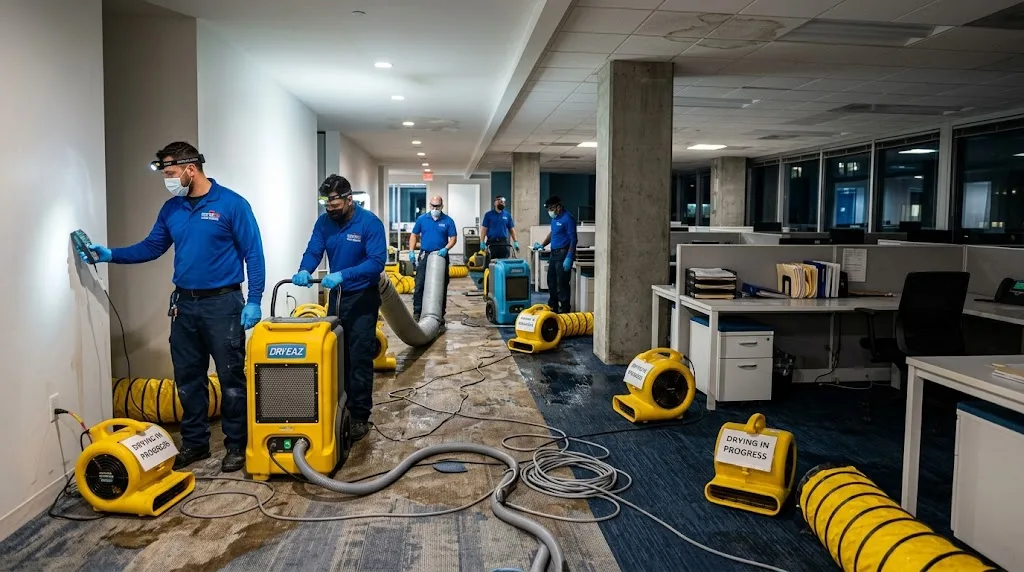
Can your Lakewood business afford to be closed for two weeks because of a water damage event that wasn’t handled correctly? Most can’t. Commercial water damage restoration has different stakes than residential — every day of closure is lost revenue, and every hour of delay allows moisture to penetrate deeper into commercial flooring, drywall systems, and inventory. The Belmar commercial district and the Denver Federal Center campus — two of Lakewood’s most significant commercial zones — contain hundreds of businesses that face water damage risk from Jefferson County’s aging infrastructure, snowmelt flooding, and the same burst pipe emergencies that affect residential properties. This guide covers what commercial water damage restoration looks like, how the process differs from residential, and how to minimize business interruption.
Commercial Water Damage in Lakewood? We Minimize Downtime.
Call (877) 698-1311 — 24/7 commercial emergency response throughout Lakewood and Jefferson County.
How Commercial Water Damage Restoration Differs from Residential
The core technical process — extraction, structural drying, mold prevention — is the same in commercial and residential restoration. The scale, documentation requirements, and business continuity considerations are significantly different.
Scale. Commercial facilities typically have larger affected areas, more complex HVAC systems that can distribute moisture throughout the building, drop ceilings that mask moisture migration, and crawlspaces or mechanical rooms that are difficult to access. Professional moisture mapping with thermal imaging across a 5,000 square foot commercial space requires more equipment and more time than a residential assessment.
Insurance documentation. Commercial policies often have higher coverage limits and more complex requirements for loss documentation. Business interruption claims — which compensate for lost revenue during restoration — require detailed documentation of the event, its cause, and the restoration timeline. A restoration company without experience in commercial insurance documentation leaves money on the table.
Code compliance. Commercial reconstruction in Lakewood must comply with IBC (International Building Code) standards and Lakewood’s commercial building permit requirements — different from residential standards. Tenant improvement work and ADA compliance considerations may apply in commercial restoration projects.
After-hours response. Commercial facilities often need extraction and setup to happen outside business hours to minimize operational disruption. We offer after-hours response for commercial clients in Lakewood and throughout Jefferson County.
Common Commercial Water Damage Scenarios in Lakewood
Roof system failure. Commercial flat roofs in Lakewood are susceptible to ponding water accumulation, particularly after heavy snowfall followed by rapid melt. A failed roof drain or compromised membrane section can allow hundreds of gallons to enter through the ceiling system before it’s discovered. The Belmar district’s mixed commercial/retail construction includes buildings with flat roof systems that require proactive maintenance to prevent water intrusion events.
HVAC condensate overflow. Commercial HVAC systems generate significant condensate that routes through drain lines to floor drains or exterior discharge points. Blocked condensate lines — from algae buildup or debris — back up and overflow into ceiling spaces, affecting large ceiling areas before anyone notices. Insurance claim assistance for HVAC-related events requires documentation of the equipment failure as a sudden event rather than a maintenance issue.
Sprinkler system activation. Fire sprinkler activations — whether from actual fire or accidental activation — discharge enormous volumes of water rapidly into the commercial space. Sprinkler water is classified Category 2 (gray water) due to the contaminants in standing water that has been in the sprinkler system, requiring more thorough decontamination than clean supply water.
Pipe burst in server rooms or data areas. Water damage in IT infrastructure areas requires coordination between the restoration team and IT personnel to protect data systems during extraction and drying. We coordinate equipment placement and access protocols to minimize additional equipment risk during the restoration process.
The Commercial Restoration Process for Lakewood Businesses
Step 1: Emergency stabilization. We arrive with the equipment scaled for your facility size and begin extraction immediately. For large commercial spaces, multiple extraction units may be deployed simultaneously.
Step 2: Moisture mapping. Thermal imaging across the full affected area identifies moisture migration that isn’t visible — particularly in drop ceiling systems, wall cavities, and under raised flooring common in commercial applications.
Step 3: Phased drying to minimize operational disruption. Where portions of the facility can remain operational, we design the drying process to contain the affected zone and allow unaffected areas to function. This is not possible in all situations, but it’s the default approach for commercial clients in Lakewood’s Belmar and commercial districts.
Step 4: Documentation for business interruption claim. We provide daily documentation of the restoration timeline, moisture readings, and equipment deployment — the records your commercial insurer requires to process a business interruption claim alongside the property damage claim.
Step 5: Reconstruction coordination. We coordinate reconstruction with your commercial contractor or manage it directly, depending on scope. All commercial reconstruction in Lakewood requires permits through the eTRAKiT system and compliance with Lakewood’s commercial building standards.
Get Your Lakewood Business Back Online Faster
Commercial water damage response throughout Lakewood and Jefferson County. Call (877) 698-1311 — 24/7 emergency dispatch.
Frequently Asked Questions
How quickly can commercial water extraction begin in Lakewood?
We dispatch within 30–60 minutes of your call for commercial emergencies anywhere in Lakewood. For large-scale commercial events requiring multiple extraction units, initial setup begins within the first hour and scales as additional equipment is deployed. Call (877) 698-1311 for 24/7 commercial emergency response.
Does commercial water damage insurance in Lakewood cover business interruption?
Commercial property policies typically include business interruption coverage as a separate endorsement that compensates for lost income during the restoration period. Coverage requires documentation of the event, the restoration timeline, and your historical revenue to calculate the interruption loss. We provide the restoration timeline documentation; your accountant typically provides the revenue documentation. Review your commercial policy before an event to confirm business interruption coverage limits.
How do we prevent mold in a commercial building after water damage in Lakewood?
Commercial buildings are not immune to the 24–48 hour mold growth timeline that affects residential properties. The same dehumidification and structural drying protocols apply — commercial equipment scaled appropriately for the space. HEPA air scrubbers running throughout the extraction and drying period prevent airborne spore counts from rising as materials dry. Post-drying air quality testing confirms the space is safe for employee and customer occupancy before reopening.
Commercial Water Damage — Lakewood's Full-Service Response
Lakewood Water Damage Pros serves businesses throughout Lakewood's commercial districts and Jefferson County. Call (877) 698-1311.
Related: